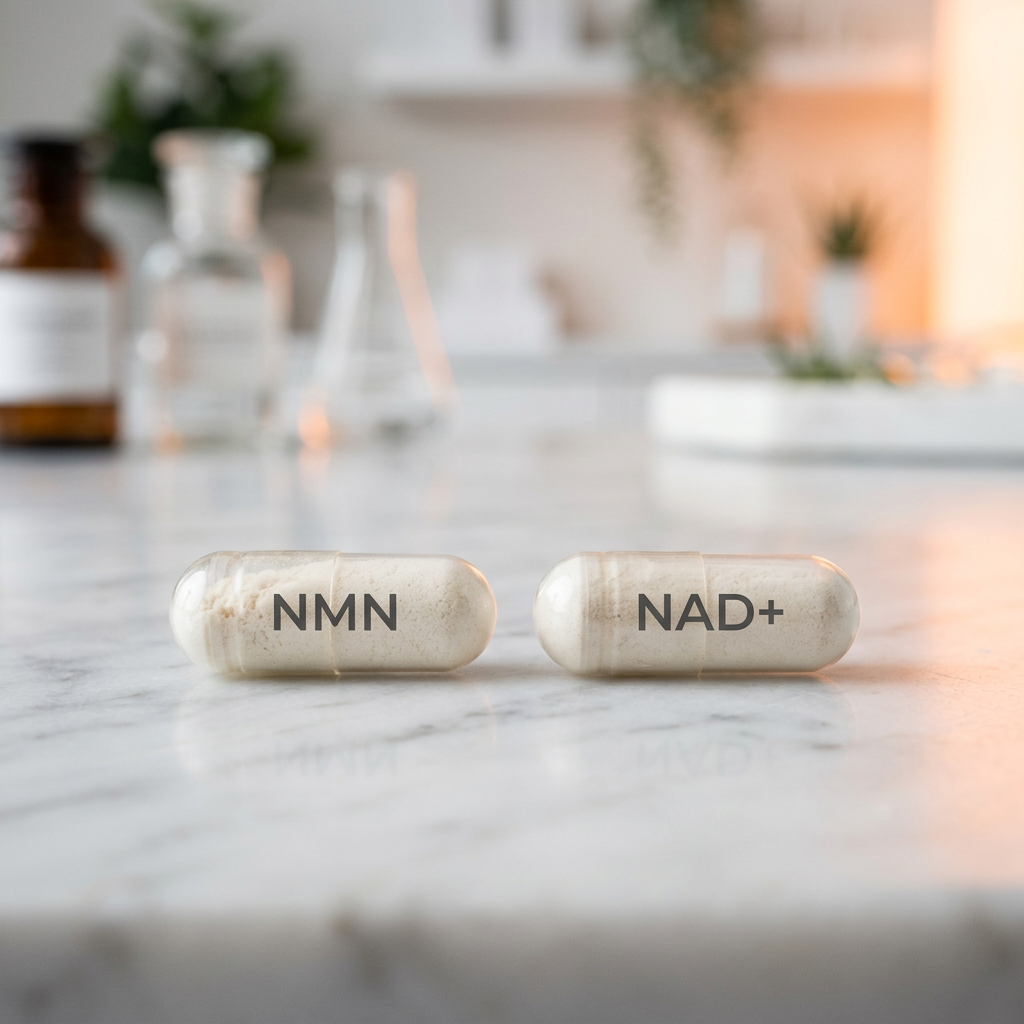
"NMN is not NAD+. It's a precursor — a starting block your body still has to convert. And that conversion is where things get complicated."
Over the past few years, NMN (Nicotinamide Mononucleotide) has become one of the most talked-about longevity supplements on the market. Promoted by researchers and influencers alike, it's positioned as a shortcut to raising NAD+ levels — the molecule at the centre of cellular energy, DNA repair, and healthy ageing.
But here's the question that rarely gets asked: if the goal is to raise NAD+, why not simply deliver NAD+ directly?
The answer matters — and it has significant implications for anyone investing time and money into their longevity. Let's break it down properly.
The Foundation
Why NAD+ matters in the first place
NAD+ (Nicotinamide Adenine Dinucleotide) is a coenzyme present in every cell of your body. It plays a central role in producing cellular energy (ATP), activating sirtuins — the longevity proteins responsible for DNA repair and inflammation control — and supporting the communication between your mitochondria and cell nucleus.
The problem is that NAD+ levels decline naturally with age — by roughly 50% between your 40s and 60s — and are further depleted by stress, alcohol, poor sleep, and illness. This decline is now understood to be a key driver of the biological ageing process itself.
Restoring NAD+ is no longer fringe science. It's a fast-moving area of legitimate longevity research — and the question has shifted from whether to restore it, to how.
The Problem With NMN
NMN is a precursor — not the molecule itself
NMN works by giving your body a raw material that it then attempts to convert into NAD+. Think of it like buying flour instead of bread — your body has to do the baking. And that conversion step introduces significant inefficiency.
When taken orally, NMN faces several hurdles before it can become NAD+: it must survive digestion, cross the gut wall, enter cells, and then be enzymatically converted through a multi-step biochemical pathway. At each stage, losses occur.
Research suggests only a fraction of oral NMN actually results in meaningful increases in cellular NAD+. The conversion efficiency also varies widely between individuals — influenced by age, genetics, gut health, and the status of the enzymes responsible for the conversion itself.
The core issue with NMN supplementation:
- Low and variable oral bioavailability (~15–25%)
- Requires multi-step enzymatic conversion before becoming active NAD+
- Conversion efficiency declines with age — when you need it most
- Difficult to achieve clinically meaningful doses orally
- Effects are gradual and hard to measure without blood testing
Head to Head
NMN vs NAD+ IV — a direct comparison
Factor
NMN (oral)
NAD+ IV
What it is
A precursor molecule that the body must convert to NAD+
The active coenzyme your cells use directly — no conversion needed
Bioavailability (oral)
~15–25% absorbed, then partially converted
~10–20% oral — but 100% when delivered intravenously
Speed of effect
Days to weeks as NAD+ levels gradually build
Cellular NAD+ levels rise within hours of IV infusion
Dose precision
Difficult to achieve therapeutic doses orally
Clinically dosed at 250mg or 500mg IV — measurable and controlled
Clinical evidence
Promising animal studies; limited human RCT data
Decades of human use; well-established safety profile in clinical settings
Cost-effectiveness
Daily capsules at $80–$150/month, ongoing
Single IV session provides acute, measurable cellular replenishment
The Clinical Advantage
Why IV NAD+ is the superior approach
When NAD+ is delivered intravenously, it bypasses the gut entirely. There is no conversion required, no absorption bottleneck, and no enzymatic pathway to navigate. The molecule enters your bloodstream and reaches your cells directly — achieving a therapeutic cellular concentration that simply cannot be replicated with oral precursors.
The results are measurable and rapid. Most clients experience a noticeable shift in mental clarity, energy, and a sense of physical restoration within the same session — feedback that's consistent across our clinical team's experience and supported by the growing body of research on IV NAD+ in restorative medicine.
IV bioavailability
vs ~15–25% for oral NMN
Time to cellular effect
vs days to weeks with NMN
Clinically dosed
Precise, measurable, supervised
Conversion steps required
Direct delivery to your cells
Who It's For
The right candidate for NAD+ IV therapy
NAD+ IV isn't only for people interested in longevity research. The most common presentations we see at Utopiya Lounge include people who are already investing in their health but feeling like they've hit a ceiling — doing everything right and still feeling depleted.
High performers
Executives, entrepreneurs and athletes pushing cognitive and physical limits who need faster recovery and sharper focus.
Current NMN users
Already spending $80–150/month on NMN capsules but not experiencing the results they expected — IV NAD+ offers a direct, measurable alternative.
40+ and feeling it
NAD+ decline accelerates significantly from your 40s. IV supplementation addresses this directly, at the dose that actually makes a difference.
Post-illness recovery
Viral illness, surgery or prolonged stress can rapidly deplete NAD+. IV therapy supports faster cellular recovery and immune restoration.
Recommended Treatment
Eterna NAD+ — Cellular Repair & Longevity
Our Eterna NAD+ drip delivers pharmaceutical-grade NAD+ directly into your bloodstream at 250mg or 500mg — the therapeutic doses your cells actually need, administered under full clinical supervision by our doctor-led team.
Common Questions
Can I take NMN and have NAD+ IV therapy at the same time?
+Is NAD+ IV therapy safe?
+How often should I have NAD+ IV therapy?
+Does NAD+ IV work better than NMN for everyone?
+